How It Works: The "Two-Key" System
The magic (and the limitation) of Private Relay lies in its dual-hop architecture. Think of it like a relay race where no single runner knows both the starting line and the finish line.
The First Hop (Apple’s Ingress Proxy): When you type a URL into Safari, your request is encrypted and sent to an Apple-operated server. This server knows who you are (your IP address and account) but, because the destination is encrypted, it has no idea where you are going.
The Second Hop (The Egress Proxy): Apple hands the request to a third-party partner (like Cloudflare or Akamai). This server knows where you are going, but it only sees the IP address of the first Apple server. It has no idea who you are.

By splitting the identity from the destination, Apple creates a system where no single entity - not even Apple - can build a profile of your browsing habits.
The "Black Box" Problem
Apple's engineers often say they want to build systems where you don't have to trust them because the math makes it impossible for them to cheat. This is where Blind Signatures come in. This cryptographic technique allows Apple to verify you are a valid iCloud subscriber without actually linking that verification to your specific data packet.
However, for the average user, this is still blind trust. You are trusting:
- That Apple’s code doesn't have a "backdoor" or a logging bug.
- That the third-party egress partners aren't secretly colluding with Apple.
- That the "anonymised" IP address assigned to you isn't unique enough to be used for fingerprinting.
While Apple is arguably more trustworthy than a random "free VPN" from the App Store, you are still locked into a black box. Unlike open-source projects, you cannot independently verify how Private Relay handles a packet at the kernel level on your iPhone.
Blind Trust: Misunderstanding The Technology
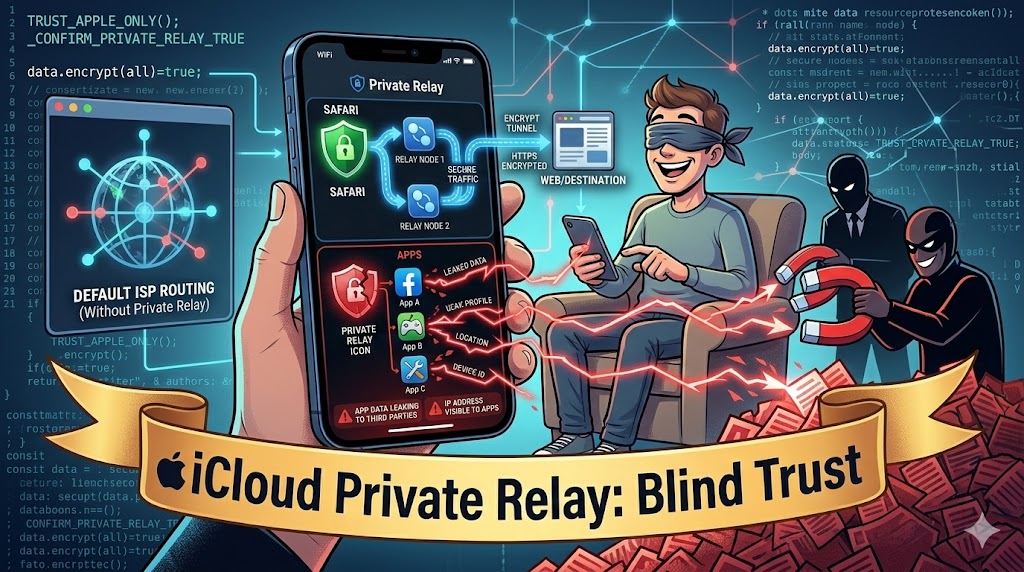
Many Apple users are under the illusion that with Private Relay, they are "hidden" and are protected from trackers, ads and data harvesting. They are not. This belief is based in the "Apple care about my privacy" fallacy.
The biggest misconception about Private Relay is that it protects your entire phone. It doesn't. It basically protects browsing in Safari and your DNS queries only.
If you open the TikTok, Instagram, Facebook, or Chrome apps for example, Private Relay is essentially useless. Those apps can still see your real IP address and track your behavior.
Furthermore, compared to Shadowsocks - a high-performance proxy specifically designed to bypass the "Great Firewall" - Private Relay is easily blocked. Many corporate networks and restrictive governments simply "sinkhole" Apple’s relay domains, forcing your phone to either fail or revert to a standard, trackable connection.
A VPN or Shadowsocks instance is much harder to kill because they can be hosted on unique, rotating IP addresses that don't scream "I am an Apple Proxy".
Apple Private Relay is a "set and forget" tool for the casual user. It's significantly better than doing nothing, and it kills the low-hanging fruit of ad-tracking in Safari but if you're looking for a tool to bypass geographic restrictions or protect your data across every app you own, you're still going to need a dedicated and trusted VPN or Ad blocker like PiHole.