The Digital Shadow: Why Your Privacy Is Under Attack
Every time you open an app or click a link, a silent conversation happens behind the scenes. You aren’t just looking at a website; that website is looking at you. In today’s world, your data is the most valuable currency, and companies are spending billions to make sure they never lose sight of you.
For most of us, the internet feels like a series of "rooms" we visit. But for advertisers, the internet is one giant, open floor plan where they follow you from the bedroom to the bank.

How They Track You Between Sites
When you browse the web, companies use "trackers" to build a fingerprint of your identity. It’s not just about cookies anymore. They look at your screen resolution, your battery level, and even the way you move your mouse.
By placing invisible "pixels" on millions of websites and emails, companies like Meta and Google know you were looking at review of new hiking boots on a small independent blog, even before you check your social media feed. This is Cross-Site Tracking, and it’s how that "random" ad finds you five minutes later.
The Meta Monopoly: Facebook, Instagram, and WhatsApp
Meta doesn't just own apps; they own a map of your life. Because Facebook, Instagram, and WhatsApp all live on the same phone, Meta can "stitch" your identities together.
- The Connection: They know the person posting photos on Instagram is the same person messaging a doctor on WhatsApp.
- Mapping the Planet: WhatsApp is the ultimate mapping tool. By accessing your contact list, Meta knows who you know, where they live, and who they know. Even if you don't have a Facebook account, they have a "shadow profile" of you because your friends have your number saved and they've agreed to allow that app access and share their phone contacts, containing your name and details. WhatsApp has apparently mapped the planet using this data - joining the dots, making the connections between contacts from their 124,000,000+ active users' phone books.
Your Defense: Pi-hole and Unbound DNS
If you want to stop the surveillance, you have to stop the "phone calls" your devices make to tracking servers. You need to stop them calling home.
This is where Pi-hole and Unbound come in.
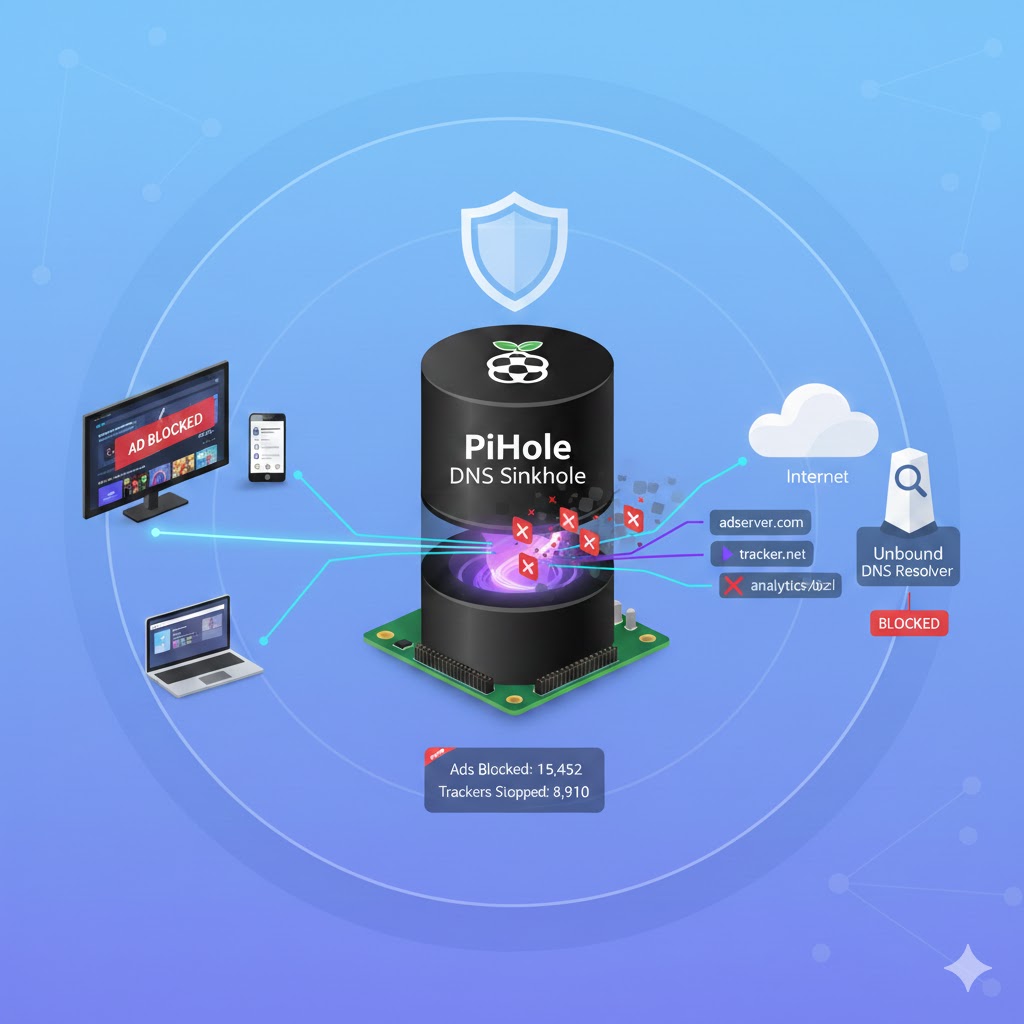
Think of Pi-hole as a black hole for advertisements. When your Smart TV or Phone tries to send your data to a tracking company, Pi-hole intercepts the request and deletes it. The "call" never goes through, and the tracker never sees you.
To understand how Pi-hole stops an ad, you have to realise that your apps and smart devices are constantly "calling out" for content.
When you open a news app, the app doesn't just download the news, it also sends out dozens of tiny requests to
https://www.google.com/search?q=ad-delivery-network.com or greedy-advertisers.net to fill the
gaps on your screen with ads.
Normally, your router would provide the address for those servers, and the ads would load. Pi-hole changes the map.
The 0.0.0.0 Response: A Digital Dead End
When an app on your phone asks, "Where is the server that provides this banner ad?", Pi-hole checks its massive list of known bad actors.
If it finds a match, it intentionally gives your phone a fake address: 0.0.0.0.
- The Trap:
0.0.0.0is a non-routable meta-address. It essentially tells the device, "This server is nowhere." - The Result: The app tries to "call" that address, finds nothing, and simply gives up. Because it happened at the DNS level (the address finding stage), the ad data is never even downloaded.
- The Benefit: This is why your pages load faster and your battery lasts longer because your device never spends the energy or data downloading the "junk" in the first place.
Interception vs Deletion
It is important to understand that Pi-hole isn't just "hiding" the ad from your eyes; it is intercepting the request before it even leaves your house. By the time the tracking company wonders why they haven't heard from your Smart TV today, it’s too late, Pi-hole has already "sinkholed" the request into the void.
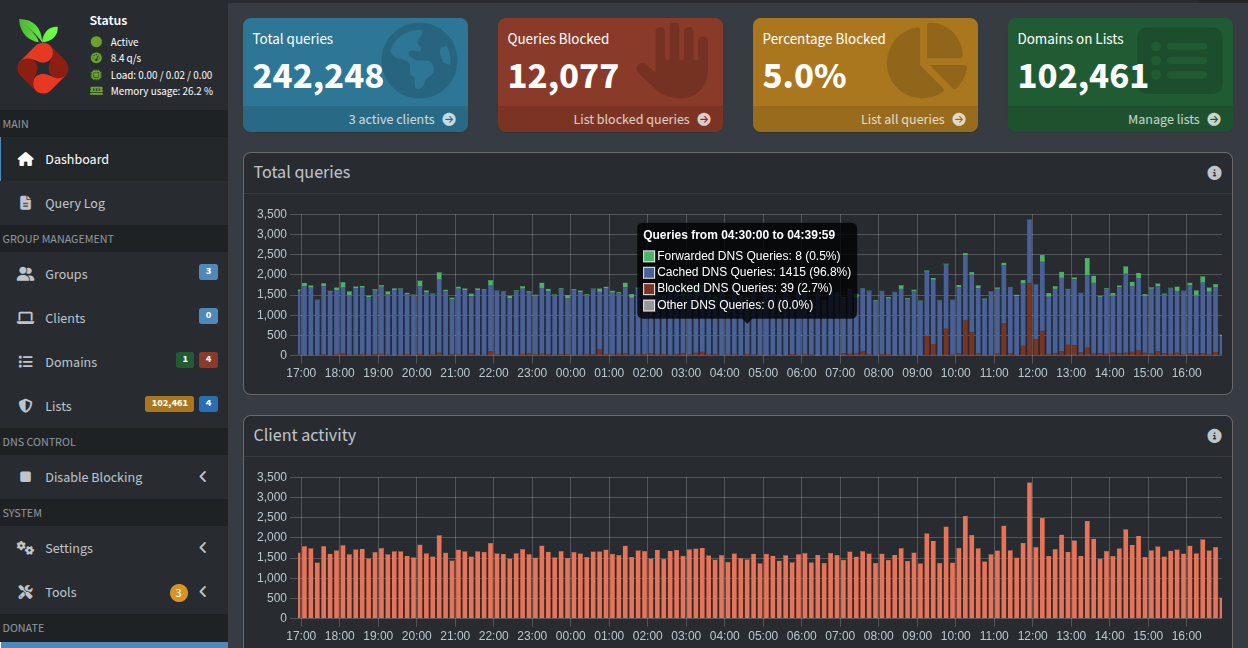
This makes Pi-hole significantly more powerful than a browser-based ad blocker because it protects devices that you can't normally install software on, like your Smart Fridge, your Ring Doorbell, or your Apple TV.
Private And Direct DNS Resolution
Unbound DNS takes it a step further. Usually, your Internet Provider (ISP) acts as the "operator" for your internet calls, seeing every site you visit. Unbound removes the middleman. It allows your network to talk directly to the source of the internet, keeping your browsing history private from your ISP and third-party snoopers.
Unbound is a Recursive DNS Resolver. Instead of asking your ISP "Where is https://www.google.com/search?q=google.com?",
Unbound does the legwork itself through a process called Recursion:
- The Root: Unbound asks the "Root Servers" (the masters of the internet) where the
.comlist is kept. - The TLD: It then goes to the ".com" servers and asks where the
https://www.google.com/search?q=google.comrecords are. - The Source: Finally, it goes directly to Google’s own authoritative server to get the address.
Because Unbound talks directly to these global sources, there is no single middleman (like an ISP or Google DNS) sitting in the middle logging your entire history. You are no longer asking for permission to find a site; you are finding it yourself.
Unbound then caches the result which means next time the site is requested, this recursive path is skipped and the information is served directly from the local cache, resulting in an even faster page load.
DNS resolution is inherently insecure and "noisy". Your ISP usually sees all DNS requests you make, but Unbound removes this leak. Unbound also provides DoH - DNS over HTTPS. DoH uses a secure HTTPS connection when performing a DNS lookup meaning the DNS resolution is 100% private.
Why This Pairs Perfectly with Pi-hole
If Pi-hole is the security guard checking IDs at the door and turning away the "bad guys" (ads/trackers), Unbound is the private investigator who finds the addresses you actually want without telling anyone where you’re going. Together, they ensure that your data stays inside your home and that no one is profiling your habits from the outside.
Why This Matters for Network Security
Privacy isn't just about hiding; it's about protection. Many malware attacks and viruses are delivered through advertisements (known as Malvertising). By blocking these ads at the network level with Pi-hole:
- Your devices run faster because they aren't loading heavy tracking scripts.
- Your network is safer because malicious "ad" links are blocked before they can even load.
- Your "Smart Home" devices are prevented from sending your private data back to manufacturers.
- You and your children are protected from endless, targeted ads.
- Links are broken between ads on TV and purchases you make in store and online.
By taking control of your DNS as well as running a network level ad blocker, you aren't just blocking ads - you are preventing companies from mapping your home, and those that live there.