Mass Surveillance: The Infrastructure of a Watched Society
Mass surveillance is no longer a dystopian concept reserved for novels. It is a rapidly expanding infrastructure quietly embedded into the modern internet. What was once targeted monitoring of criminal suspects has evolved into population-scale data harvesting - where entire societies are logged, profiled, scored, and analysed.
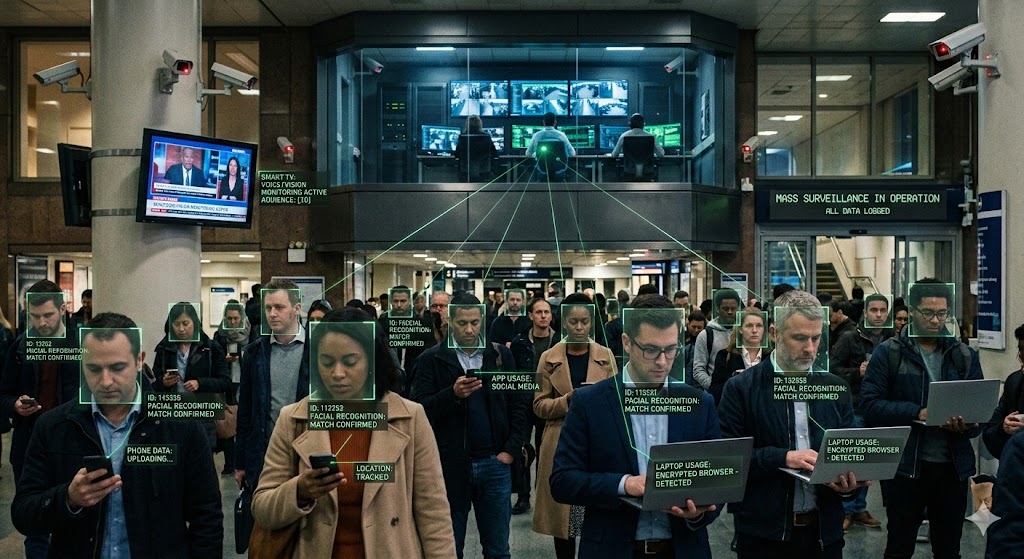
Governments and corporations increasingly justify these systems using language like: "national security", "counter-terrorism" and "protecting children". But behind these scaremongering narratives lies a technological architecture designed for continuous identity tracking and behavioral monitoring. Of course people no longer buy the "national security" and "counter-terrorism" lines any more, they've been played all too often.
The latest heart-string-pulling narrative from the government and mainstream media to unite the flock is "protecting children".
The Simpsons - Think of the children from 12 years ago has become a meme.
The Digital ID Shift: From Optional to Inevitable
With the introduction of the "age verification", the modern internet is shifting from anonymous access to mandatory identification. And that shift changes everything.
Kier Starmer introducing the 'mandatory' Digital ID in the UK.
For decades, the internet allowed pseudonymity. You could browse, read, and speak without tying every action to your legal identity. That era is ending.
These sweeping changes are coming in under the Online Safety Act (OSA); introduced to Parliament as the Online Safety Bill on 17 March 2022, it received Royal Ascent in October 2023.
This legislation promised:
- Stronger protections for children.
- Criminal offences for sending harmful or false communications.
- New offences related to cyberflashing.
- Greater powers for the regulator Ofcom.
- Duties on platforms regarding illegal content and content harmful to children.
In reality however, this legislation is being constantly changed to take it beyond its initial scope and is being used to allow the implementation of systems for mass surveillance of everybody.
The short video titled "And then?" from Swedish firm, Mullvad VPN sums up what happens. Surveillance is requested on X, and then Y and then Z. The dragnet widens fast and before long, we're all caught up in the surveillance net. This advert was banned in the UK.
Mullvad VPN Short video and advert - banned in the UK.
That's just the UK: That Won't Affect Us!
Is this just in the UK? Of course not! It's the Five Eyes Alliance (UK, US, Australia, Canada and New Zealand) who are all in bed together. The very same countries implementing harsh lockdowns, mandatory mass vaccinations and vaccine passports not that long ago.
- UK: Active age verification requirements in law and enforcement
- US: Patchwork of state laws and proposals, no unified federal mandate
- Australia: Mandatory age restrictions with verification
- Canada:Federal bill proposed (not yet law)
- New Zealand: Proposed age verification bill
Many say the pandemic was used as a trial run for this technology through contact tracing, mandating so-called "vaccine passports" and controlling free movement.
All that newly deployed infrastructure from 2020 has not gone to waste, it has been further built upon to form the framework for the Digital ID, coming to us all.
Across Western nations, digital ID frameworks and so-called "age verification" laws are being introduced as tools to protect minors from harmful content. On the surface, this appears reasonable. Few would argue against safeguarding children.
But examine the mechanics more closely.
- Mandatory Identity Proofing: Users must upload government-issued ID, facial scans, or biometric data to access websites.
- Persistent Identity Tokens: Once verified, systems generate reusable digital credentials that can link activity across platforms.
- Centralized Data Storage: Identity providers store vast amounts of sensitive personal information.
The result is not simply age verification - it is the normalization of identity-gated internet access and surveillance.
The Data Brokers Behind the Curtain

Many age verification and digital identity systems are outsourced to private technology firms specialising in biometric processing and large-scale data analysis.
Companies like Yoti, Palantir and Persona provide facial age estimation, document verification, and biometric matching services. These systems often require users to submit:
- Passport or driver’s licence scans
- Live facial video or selfies
- Behavioral biometric signals
While these companies state that data is handled securely, the broader concern is structural: once identity becomes mandatory for access, vast amounts of personal data inevitably flow into centralised verification networks and platforms.
These firms specialise in aggregating massive datasets for governments and intelligence agencies. Their platforms are designed to correlate identity records, behavioral patterns, financial data, and geolocation metadata at scale.
Individually, these tools may serve administrative purposes. Collectively, they form the scaffolding of continuous population monitoring.
The "Protecting Children" Framework
The phrase "protecting children" has become the political catalyst for Digital ID expansion. Age verification laws in multiple Western countries require platforms to verify user age before granting access to certain categories of content.
But technically, verifying age without identifying the individual is extremely difficult. Most systems default to identity proofing rather than anonymous age estimation.
This creates a subtle but powerful precedent:
- Access to information becomes conditional on verified identity.
- Browsing history can be permanently linked to real-world identity.
- Anonymity becomes suspicious rather than normal.
- Privacy also becomes "you have something to hide".
Over time, this transforms the internet from an open publishing platform into a permission-based network.
The Five Eyes and the Western Surveillance Model
The intelligence alliance known as the Five Eyes Alliance - comprising UK, US, Australia, Canada, and New Zealand - has long cooperated on signals intelligence sharing.
Revelations over the past decade demonstrated that bulk data collection was not limited to foreign adversaries, but often included domestic communications metadata.
Today, surveillance in these countries is increasingly characterised by:
- Telecommunications data retention laws
- Online safety regulations requiring identity verification
- Expansion of facial recognition in public spaces
- Financial transaction monitoring and digital payment traceability
The shift is gradual. It rarely feels dramatic. But structurally, the direction is clear: identity-first access, centralised monitoring, and automated risk profiling.
Surveillance on a mass scale
China's Social Credit System: A Fully Integrated Model
The Chinese Social Credit System.
No discussion of surveillance architecture is complete without looking the system developed in China.
The Chinese Social Credit System is often described as a single nationwide score. In reality, it is a complex network of regional pilot programs, blacklists, corporate compliance ratings, and behavioral enforcement mechanisms.
At its core, the system aggregates:
- Financial records
- Legal compliance data
- Administrative penalties
- Court judgments
Individuals or businesses that violate regulations can face restrictions on travel, access to loans, or public procurement participation and even have their face and information shows on billboards nationwide.
Critics argue that it represents the logical endpoint of centralised digital governance: a society where behavior, compliance, and access are algorithmically mediated.
While Western systems differ structurally and politically, the technological components - biometric ID, centralised databases, AI analytics, and predictive profiling are increasingly similar.
From Open Internet to Permission Based Network
The defining feature of the early internet was permissionless participation. Anyone could publish a website, join a forum, or access information without first submitting identification.
Mass Digital ID systems reverse that assumption.
- Access becomes conditional.
- Anonymity becomes restricted.
- Privacy becomes difficult or impossible to maintain.
- Every action becomes attributable.
Whether implemented through age verification laws, digital identity wallets, or biometric authentication, the architecture increasingly resembles a monitored utility rather than a decentralised platform. Heading towards China's idea of a digital society.
The Core Question
Surveillance technology is not inherently authoritarian. It can serve administrative efficiency, fraud prevention, and security goals.
The question is not whether tools like biometric ID or large-scale analytics exist. They do.
The question is whether societies impose limits on this tech:
- Strict data minimisation
- True anonymisation laws and standards
- Transparent oversight
- Clear expiration and deletion policies
Without those guardrails, systems introduced for narrow purposes can expand quietly and permanently. We are seeing this happen already and because this serves the government, there seems to be a total disregard of the EU and UK GDPR legislation.
The transformation rarely arrives with dramatic announcements. It arrives through policy framed as safety, implemented through private contractors, normalised through convenience, and accepted through gradual habituation.
And once identity becomes the price of access, the architecture of mass surveillance is no longer theoretical - it is infrastructural.