In recent years, the Virtual Private Network (VPN) has evolved from a niche corporate tool into a household essential. While often portrayed by the mainstream, legacy media and in political spheres as a "cloaking device" for illicit activity, the reality is far more grounded: it is a fundamental pillar of modern cybersecurity and privacy.
Why a VPN is Your Home's First Line of Defence
Using a VPN at home isn't about having something to hide; it's about having something to protect.
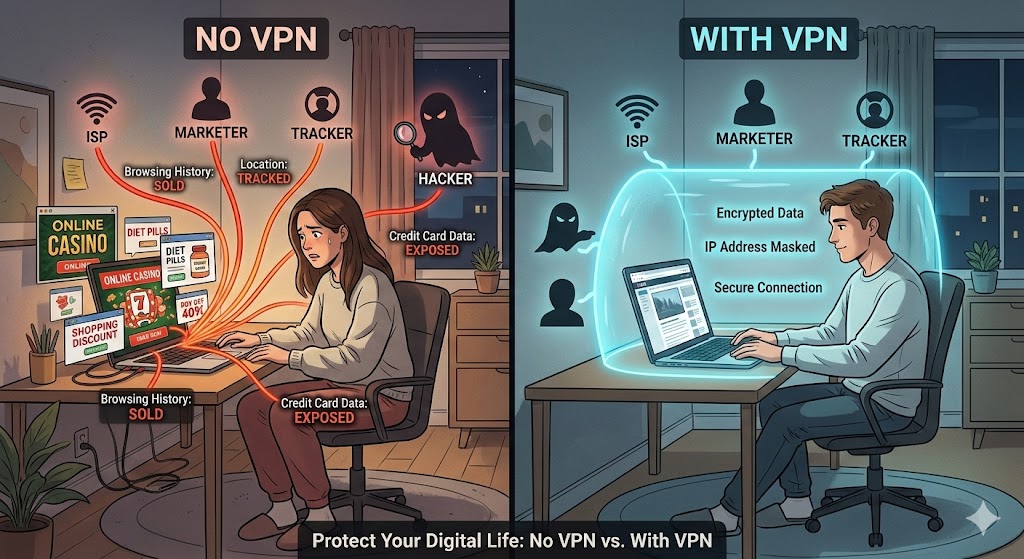
- Privacy and Anti-Tracking: Without a VPN, your Internet Service Provider (ISP) sees every website you visit. This data is often packaged and sold to advertisers. A VPN encrypts your traffic, turning your browsing history into gibberish for anyone sitting between your device and the VPN server.
- Malware and Ad Blocking: Many premium VPNs now include Threat Protection features. These work at the DNS level to block known malicious domains and intrusive trackers before they even load on your browser, preventing "malvertising" attacks.
- Public Wi-Fi Safety: When you leave the house, a VPN becomes even more critical. Public Wi-Fi is notorious for "Man-in-the-Middle" attacks, where hackers intercept data. A VPN ensures that even on an open network, your data remains inside an encrypted "tunnel."
The "Ban" Myth: Why VPNs are Too Big to Fail
Governments, particularly in the UK under the Online Safety Act, have recently targeted VPNs as "loopholes" that allow users to bypass age-gating and content filters. Some politicians have even floated the idea of an outright ban 🤦 However, a total ban is technically and economically impossible for three major reasons:
- The Backbone of Global IT: VPNs are not just apps; they are the foundation of the modern economy. Every major bank, healthcare provider, cloud provider and multinational corporation uses VPN protocols (like IPsec and TLS) to allow employees to work remotely and to secure internal data transfers. Banning the technology would effectively shut down the City of London and every remote-work infrastructure in the country.
- Integration in the OS: You cannot "ban" an app to stop VPN use because the protocols are baked into the hardware. Linux, Windows, macOS, iOS, and Android all have native VPN settings. Even if a government forced Apple and Google to remove VPN apps from their stores (age-gating or otherwise), a user could still manually enter server details into their phone's settings to establish a secure connection.
- The "Cat and Mouse" Reality: Even in countries with highly restrictive "Great Firewalls", VPNs persist. They use "obfuscated servers" that make VPN traffic look like regular HTTPS web traffic. An outright ban would require a level of national surveillance and "Deep Packet Inspection" (DPI) that would break the functionality of the internet itself.
The UK Online Safety Act and Circumvention
The UK's Online Safety Act has introduced mandatory age verification for various sites under the guise of "protecting children" from harmful content. This has led to a massive surge in VPN usage - not necessarily by people looking for illegal content, but by privacy-conscious adults who do not wish to hand over their credit card or passport details to third-party verification companies with questionable security records.
The government views this as "circumvention," but for the end-user, it is often a matter of data minimisation and that concept governments and legacy media find hard to grasp, privacy. By using a VPN to appear as if they are in a different jurisdiction, users can access the open web without creating a digital trail of their most sensitive identity documents.
Schools Narrative On VPN's For Parents
In the current digital landscape, schools and legacy media often frame VPNs as a significant risk to child safety, primarily because they act as a "digital tunnel" that can bypass the safety barriers built by institutions.
Why Schools and Media Are Warning ParentsThe narrative usually focuses on the "circumvention" aspect of the technology rather than its security benefits. Here are the two primary arguments I frequently hear in educational policies and media reports:
The "Loophole" in New Laws
Claim: With the implementation of laws like the UK’s Online Safety Act, media outlets have labeled VPNs as a "loophole" that allows minors to evade age-verification checks on social media and adult sites by appearing to browse from another country.
Response: The overwhelming majority of these cases are adults using VPN's to circumvent the so-called "age verification" and data harvesting that has been forced upon them under this new legislation. Why? Because this is not just AGE VERIFICATION, this is part of the MASS SURVEILLANCE dragnet where personal data and sensitive documents are checked against 260 databases and watch lists, stored online and subsequently lost in data breaches.
Security Risks of "Free" Services
Legacy media often highlights the dangers of free VPN apps. Many of these apps are "scams" that may sell user data or, in some cases, use a "peer-to-peer" model where other people’s internet traffic is routed through the child's device, potentially linking illegal activity to the family's IP address.
Response: Laughable. Yes, some free VPN services pose a risk, but choosing a trusted VPN provider like Proton VPN or Mullvad VPN, there is no argument here. In fact, using paid and trusted services, your personal data is protected. The selling of data comes from unprotected users.
VPN Ads Banned In The UK
The UK is escalating its censorship and mass surveillance. When Mullvad tried to address this with the TV ad "And Then?", it was banned on British TV. The outdoor ad campaign meant to criticise the TV ban was also largely halted.
Mullvad VPN Short video and advert - banned in the UK.
Summary of VPN Utility
- Encryption: Prevents ISPs and hackers from snooping on your traffic.
- IP Masking: Stops websites from tracking your physical location.
- Thread Protection: Blocks ads, trackers, and malicious websites at the source.
- Remote Access Essential for secure work-from-home and corporate stability.
Ultimately, while the government may attempt to introduce "age-gating" for VPN apps, the underlying technology is a permanent fixture of the internet. It is a vital tool for anyone who values their digital autonomy and security in an era of increasing surveillance.